TEMPO.CO, Jakarta - The price of oil soared to nearly $120 a barrel on Monday after Israel struck Iran's energy infrastructure over the weekend and Tehran announced Mojtaba Khamenei as the country's new supreme leader.
The attacks, which marked a major escalation in the 10-day-old conflict, sent fresh fears throughout global energy markets, with Brent crude reaching $119.50 (€103.30) a barrel.
It later fell back to around $100, and on Tuesday, oil was trading below $90 a barrel, but still more than 20% higher than when the war started on February 28.
The worsening conflict raises the risk to energy infrastructure across the Middle East, where producers are already grappling with damaged sites from Iranian attacks and the closure of the world's most critical oil shipping route.
With diminishing storage facilities for exports, DW asks whether Gulf oil production could be shut down within days.
Why is a shutdown of Gulf oil production looming?
Oil-producing Gulf states—Saudi Arabia, United Arab Emirates (UAE), Qatar, Kuwait and Bahrain—have been directly caught in the crossfire of the US-Israel war with Iran.
Iran drew Gulf states into the conflict by launching strikes on energy facilities, airports, hotels and residential areas, as well as US military sites in the region. These moves sparked accusations of "treacherous" behavior and the threats of potential military retaliation.
Compounding the pressure, Iran's de facto closure of the Strait of Hormuz—a narrow waterway between Iran and Oman that connects the Persian Gulf to the Gulf of Oman and the Arabian Sea—has halted nearly all commercial traffic, according to shipping analytics firm Kpler.
Hormuz carries about one-fifth of the world's oil supply, making it a critical chokepoint in energy trade, and its closure is considered a worst-case scenario for global energy markets.
What's happening to preexisting oil supplies?
With oil and LNG tankers stuck, Gulf producers are hoping that the strait will reopen soon.
While Saudi Arabia and the UAE have alternative routes for exporting some of their energy through the Red Sea and the Gulf of Oman, other Gulf producers can rely only on diminishing storage capacity.
Collectively, Gulf nations can store about 343 million barrels of oil to delay an inevitable production stoppage, according to the US investment bank, JP Morgan.
However, roughly 15 million barrels per day of crude, plus more than 4 million barrels per day of refined products like gasoline, diesel and jet fuel, typically flow through the Strait of Hormuz.
JP Morgan calculated that Gulf states collectively had just 22 days of storage buffer on the day the war unfolded.
Although by Tuesday, reports of isolated oil tanker transits through the Strait of Hormuz persisted amid the ongoing conflict, Iran's Islamic Revolutionary Guard Corps (IRGC) issued stark warnings.
The IRGC declared that Tehran would "determine the end of the war" and vowed not to allow "one liter of oil" to be exported from the region if US and Israeli attacks continue.
What signs point to a possible production halt?
Iraq, which had just six days of storage, has likely already exhausted its stockpiling capacity, prompting output cuts of around 1.5 million barrels per day by Baghdad last week.
Rystad Energy, a Norwegian research company, warned on Monday that Iraq's remaining operational oil fields "face an imminent, near-certain shutdown."
Saudi Arabia, meanwhile, had 66 days of storage on February 28, according to JP Morgan. This figure assumes that the kingdom could redirect some of its oil exports via other routes.
Rystad Energy believes the Saudis may only have an "effective runway before forced output cuts" of seven to nine days.
Saudi Aramco, the world's largest oil exporter, is rerouting as much oil as possible to the Red Sea port of Yanbu, while the UAE is redirecting some of its exports through Fujairah, which was also struck by Iran.
These alternative routes only account for a third of the oil that usually flows through the strait.
Bloomberg News reported Tuesday that the Saudis have lowered oil output by up to 2.5 million barrels a day, while the UAE cut its output by 500,000 to 800,000 barrels a day.
Kuwait has also cut output by half a million barrels a day, and Iraq by about 2.9 million, Bloomberg added, citing people with knowledge of the matter.
What would a Gulf shutdown mean for oil prices?
A complete halt to much of oil production and exports from the Gulf would almost certainly propel prices much higher, as the region accounts for roughly one-third of the world's seaborne crude oil.
Qatar’s energy minister told the Financial Times on Friday that crude could hit $150 a barrel if the conflict isn’t resolved soon and a halt in production is necessary.
Saudi Aramco warned Tuesday of "catastrophic consequences" if shipping in the strait continues to be disrupted.
Dutch bank ING said in a research note on Monday that "the longer this goes on, the more supply we will see shut-in," meaning deliberately curtailed or halted due to no outlet for the oil.
The International Energy Agency said Monday that "prolonged supply disruptions" could flip the market from a "significant surplus" since the start of last year "into a deficit."
Restarting production after even a temporary halt could prove challenging, taking days to weeks to fully resume flows, while a prolonged shutdown risks complications like equipment failures or geological issues.
What damage has been done to Gulf energy sites?
After Iranian drones on March 2 targeted Saudi Aramco's largest refinery, Ras Tanura, Saudi authorities shut down the facility to assess the damage. Ras Tanura has a refining capacity of 550,000 barrels per day and is also a major crude export terminal.
On the same day, Iran also struck Qatar's Ras Laffan, the world's largest liquefied natural gas (LNG) export facility.
QatarEnergy halted operations and declared a force majeure on exports—a clause in contracts that allows companies to get out of delivery obligations due to war and natural disasters.
Although Iranian President Masoud Pezeshkian apologized to Gulf neighbors on Saturday and vowed to stop the attacks, sporadic strikes have continued.
On Monday, an overnight drone attack hit Bahrain's Sitra island, including the sprawling Al Ma'ameer oil refinery complex, prompting another force majeure on shipments due to the damage.
The Saudi Defense Ministry said Monday that its air defenses intercepted and destroyed four drones heading toward the Shaybah oil field in the southeast.
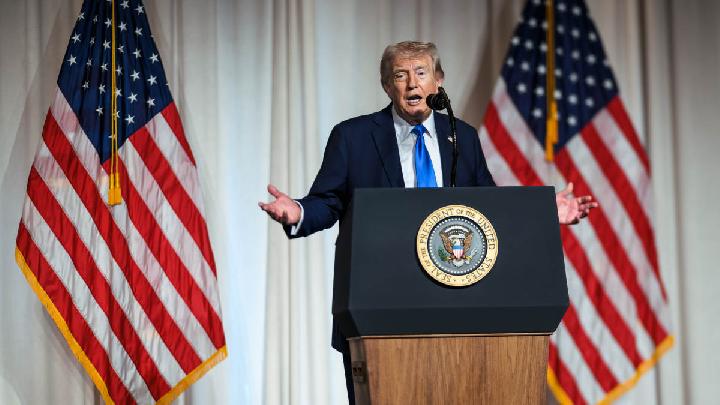
While US President Donald Trump claimed on Monday evening that the war would be over "very soon," Iran launched further strikes on Kuwait, Bahrain and the UAE early Tuesday, while Saudi Arabia said it destroyed two drones over its oil-rich eastern region.
Read: Iran Vows to Continue Oil Blockade Until US-Israel Attacks End
Click here to get the latest news updates from Tempo on Google News