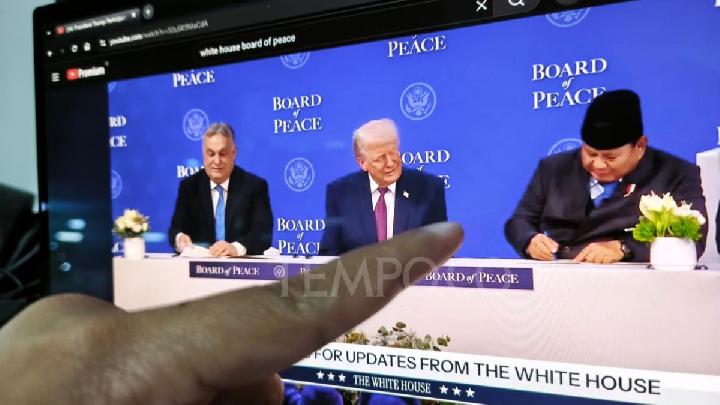
CENTER on Reform on Economics (CORE) Indonesia assesses the reciprocal tariff agreement between the United States (US) and Indonesia as a new pattern of economic exploitation of developing countries. The White House itself refers to the agreement as a 'Great Deal' that will usher in a new era of Indonesia-US relations.
According to CORE, the 45-page agreement details indicate the US's ambition to exploit the Indonesian market. "We also believe that the negotiating team failed to voice the interests of domestic industries and consumers," CORE wrote in a press release on Friday, February 20, 2026.
CORE assesses the extraordinary disparity between Indonesia's obligations and those of the US. CORE highlights the increase in Indonesia's commercial commitments, which previously amounted to US$ 22.7 billion but have now risen to US$ 33 billion in the final document.
"In fact, looking at the latest document that was finalized and agreed upon on February 20, 2026, Indonesia is not only battered, but also loses its dignity and independence to manage the economy based on national interests," CORE wrote.
CORE states that the US seems to lock all policy aspects based on their interests, from investment, agriculture, critical minerals, digital trade, trade in goods and services, and insurance services industry.
The following are CORE's five key views on the US-Indonesia tariff agreement:
1. What Indonesia gains is highly disproportionate to the obligations it has to pay
Although Indonesia's tariffs have been reduced to 19 percent, many other countries receive much lower tariffs. On the other hand, Indonesia must pay a commercial commitment of US$ 33 billion, invest in the US, and bear specific commitment clauses that include comprehensive regulatory reform and unlimited investment opening. Meanwhile, the US only gives a reduction in tariffs that was previously non-existent and can impose additional tariffs unilaterally and can terminate the agreement with a 30-day notice.
2. Rearranging non-tariff policies such as inspections and certifications has eroded the state's role in protecting domestic producers and consumers
The rearrangement of various non-tariff policies for agricultural products, cosmetics, pharmaceuticals, digital technology, and others has endangered domestic consumers. In addition to further facilitating the flow of US products into the Indonesian market, the elimination of non-tariff policies also potentially erodes the opportunities for insurance service industries from Indonesian companies, both state-owned and private. Furthermore, Indonesia is mentioned to have to remove the 'halal certification' obligation. Indonesia also has to remove the obligation of labeling or certification for non-halal US products. This condition is not in line with the values held by Muslim consumers in Indonesia, which number around 240 million people.
3. The US seems to prioritize its national interests by eliminating and suppressing the national interests of other countries
Various obligations for Indonesia in the agreement details show that what Indonesia has to do is far greater than what Indonesia will get. Indonesia even has to always consult and comply with US requests to pave the way for US companies to penetrate the Indonesian market.
Not only that, Indonesia also has to review the practices of foreign companies that could harm the US trade balance, including supporting efforts to eradicate transshipment practices that are deemed harmful to the US. Indonesia is even threatened to receive reciprocal tariffs of 32 percent if the Indonesian government makes a trade agreement with another country that potentially endangers US national interests. This clause effectively limits Indonesia's sovereignty in establishing economic cooperation with other countries.
4. Indonesian exports are unlikely to gain much benefit, while the potential for increased imports of goods and services will be higher
One of Indonesia's leading exports, such as textiles and apparel, will indeed be exempt from reciprocal tariffs. However, this 0 percent reciprocal tariff will only apply to a specific export quota, so in reality, new restrictions actually emerge from the quota policy side. On the other hand, Indonesia has to remove all import quota policies, licenses, and tariff restrictions on US products. The US also asks Indonesia to provide broader access to service companies by US companies, such as digital and financial companies. In this context, the elimination of tariffs for Indonesian manufactured products is just an illusion.
5. Downstreaming is threatened, and farmers are increasingly cornered
Indonesia is required to remove restrictions on the export of critical minerals, divestment requirements, and local content in the mining sector. This is contrary to the spirit of Law No. 3 of 2020 concerning domestic downstreaming. In the agricultural sector, liberalization has proceeded most drastically through the removal of the commodity balance policy, granting permanent status to fresh food of plant origin for US plant products, and automatic listing of facilities for US meat, poultry, and dairy. The commitment to purchase agricultural products worth US$4.5 billion with a very specific minimum annual volume seems more like an effort to address the US agricultural crisis rather than benefit the Indonesian people.
Meanwhile, excluding US companies from the Domestic Component Level (TKDN) obligation in the manufacturing sector creates unfairness for other investors who have been building factories in Indonesia and weakens the domestic industrial deepening strategy.
Editor's Choice: Dampak Kesepakatan Dagang RI-AS terhadap Neraca Perdagangan