
August 29, 2026 | 12:05 pm
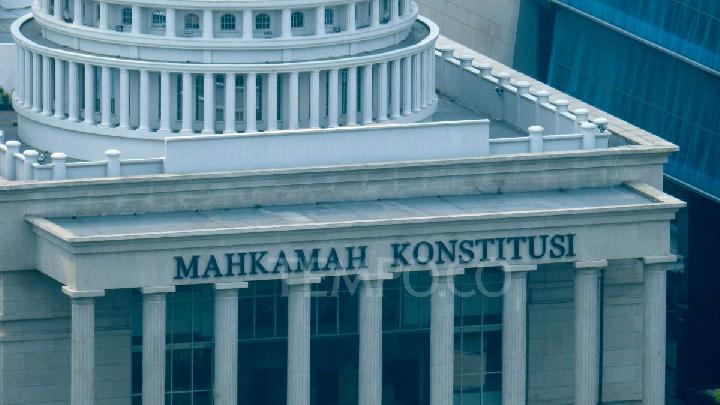
TEMPO.CO, Jakarta - Indonesia’s Constitutional Court has declared Articles 240 and 241 of Law No. 1 of 2023 on the Criminal Code (KUHP) unconstitutional and no longer legally binding. The two provisions regulated insults against the government and state institutions.
The ruling was delivered in the hearing of case No. 282/PUU-XXIII/2025 at the Constitutional Court building in Jakarta on Friday, August 28, 2026.
“The Court declares that Article 240 and the Elucidation of Article 240 of Law No. 1 of 2023 on the Criminal Code, as well as Article 241 of Law No. 1 of 2023 on the Criminal Code, are contrary to the 1945 Constitution and have no binding legal force,” Constitutional Court Chief Justice Suhartoyo said while reading the ruling.
The Court found that provisions criminalizing insults against the government or state institutions had the potential to become instruments that could restrict, or even eliminate, citizens’ constitutional rights as guaranteed by the 1945 Constitution.
State Institutions Must Be Open to Criticism
Constitutional Justice Adies Kadir said the Court found that Article 240, along with its elucidation, and Article 241 of Law No. 1 of 2023 placed state institutions as objects protected by provisions prohibiting insults.
The Court reasoned that state institutions are legal entities that do not possess feelings, including the capacity to feel praised, criticized, or insulted. If such protection is based on the need to preserve the dignity or honor of state institutions, the individuals within those institutions also have an obligation to uphold their institutions’ dignity by carrying out their duties and functions in accordance with the purposes for which they were established.
“In this regard, in carrying out their duties and authorities, the government and/or state institutions must be open to public oversight, criticism, and opinions from the people as the holders of sovereignty,” Adies said.
Court Warns of Criminalization and Chilling Effect
In its considerations, the Court also accepted the petitioners’ argument that the provisions left room for subjective interpretation in law enforcement. The situation could potentially lead to the criminalization of legitimate criticism, evaluation, and opinions, while creating a chilling effect among members of the public.
“Thus, they could create the threat of criminalization against legitimate criticism, evaluation, and opinions and could produce a chilling effect among the public in openly expressing their thoughts and views,” Adies said.
The Court also stated that Article 240, along with its elucidation, and Article 241 of the Criminal Code did not guarantee a number of constitutional rights protected under the 1945 Constitution.
These rights include the right to recognition, guarantees of protection and fair legal certainty, and equal treatment before the law; the freedom to express thoughts and views in accordance with one’s conscience; the freedom of association, assembly, and expression; as well as the right to communicate and obtain information.
The rights are guaranteed under Article 28D paragraph (1), Article 28E paragraphs (2) and (3), and Article 28F of the 1945 Constitution. Based on these considerations, the Court found the petitioners’ arguments to be legally well-founded in their entirety.
“In accordance with the principle of popular sovereignty, the voices and aspirations of the people must serve as a guide for every state institution in carrying out its constitutional duties and functions in accordance with the 1945 Constitution,” Adies said.
Petitioners Challenge Vague Definition of ‘Insult’
The petition challenging the two provisions was filed by several Indonesian citizens, including Tania Iskandar, Sila Fide Novira Nggebu, and Muhammad Restu, along with six other petitioners.
The petitioners argued that the existence of Article 240 of the Criminal Code placed them in a vulnerable position, exposing them to restrictions and possible criminalization when exercising their constitutional rights.
According to the petitioners, the phrase “insulting the government or state institutions” lacked a clear definition or objective parameters. They argued that this created broad room for subjective interpretation, particularly in distinguishing criticism, academic assessments, political expression, and other forms of expression from acts categorized as insults.
Read: Prabowo Visits New Homes for Senen Railway Trackside Residents
Turkish Court Orders X to Block Imamoglu Candidacy Account
24 hari lalu

Ekrem Imamoglu, a leading opposition figure, is widely seen as the main challenger to President Recep Tayyip Erdogan's 23-year rule.
Germany: Iraqi Sentenced to Life for Enslaving Yazidi Girls
46 hari lalu

The man and his former partner are accused of holding two Yazidi girls captive for years, abusing and torturing them before handing them to IS members
Judge Orders $5.8M be Paid to E. Jean Carroll in Trump Case
50 hari lalu

The money has been held in escrow since 2023 after a jury found Trump liable for sexually assaulting and defaming a former Elle columnist.
Why Two of Nadiem Makarim's Lawyers Face Ethics Complaints
52 hari lalu
Jamsaki has reported two of Nadiem Makarim's lawyers to the court and Peradi over their conduct following his corruption case verdict.
Austrian Court Convicts 2 Former Syrian Officials of Abuse
53 hari lalu

An Austrian court on Monday convicted two officials under Syrian former dictator Bashar al-Assad for torturing opponents of his regime.
Indonesian Lecturer Tells Court His Rp3.3 Million Pay Is Too Low
55 hari lalu
A non-civil servant lecturer at Unair reveals receiving a salary of Rp3.3 million and experiencing financial difficulties affecting independence.
Google Faces EU Top Court Ruling on Record 4.1 Billion Euros Fine
58 hari lalu

The EU's top court will decide Google's appeal against a record antitrust fine after it claimed the bloc unfairly punished innovation.
Trump Pushes New Election Rules Despite Court Setbacks
29 Juni 2026

US President Donald Trump is intensifying efforts to reshape election rules ahead of the 2026 US midterm elections, despite court setbacks.
Court Sets Next Week for Nadiem Makarim Sentencing Hearing
23 Juni 2026

The Corruption Court is scheduled to read the verdict for Nadiem Makarim in a session on Tuesday, June 30, 2026. The judges have begun to draft the decision.
Sultan Hotel's Court-Mandated Eviction Deemed Indonesia's Largest
19 Juni 2026

The spokesperson of the Central Jakarta District Court claims the execution of Sultan Hotel sets a record in the country's civil cases.