TEMPO.CO, Jakarta - Around a thousand X accounts spread a narrative claiming victory for China’s J-10 fighter jet over France’s own Rafale jets. The information operation also targeted Indonesia. This report is part of the Indo-Pacific Resilience Program supported by Internews and the European Union.
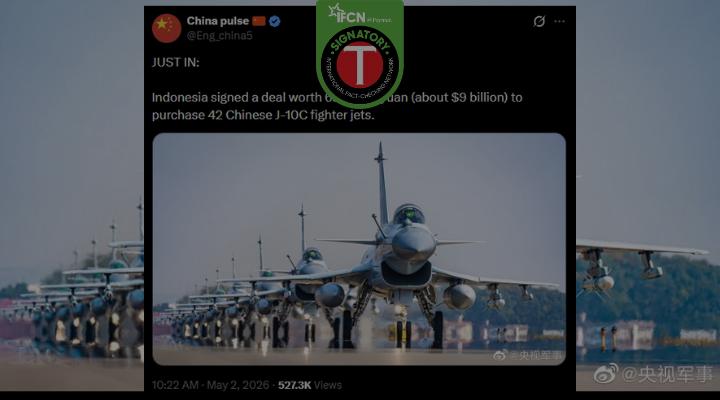
AS many as 14 English-language accounts on X claimed that Indonesia had signed a deal to buy 42 J-10 fighter jets from China. The transaction was said to be worth US$9 billion.
The information, which began circulating on May 2, 2026, drew around 13,500 interactions from internet users. Several accounts praised the decision as the right move, arguing that the J-10 had shown superior performance when used by Pakistan against India a year earlier.
“The decision was made after the J-10C’s performance proved satisfactory in air combat involving the Pakistan Air Force against India in May 2025,” wrote the account Border Watch Pakistan on Sunday, May 3, 2026.
The government denied the claim. Indonesian Army Brig. Gen. Rico Ricardo Sirait, Defense Information Bureau Chief at the Ministry of Defense, said the government was still exploring various fighter jet options available on the market.
“Indonesia has not decided to buy the J-10 from China,” Rico said via WhatsApp message on Thursday, May 8, 2026.
Intense aerial combat marked the India-Pakistan war in Pahalgam, Kashmir, on May 7-10, 2025. India deployed French-made Dassault Rafale jets, while Pakistan relied on Chinese-made J-10Cs. On the first day, Pakistan’s success in shooting down an Indian Rafale drew widespread attention on social media.
Indonesia signed contracts to procure 42 Rafale units in 2022-2024. But in October 2025, the Ministry of Defense announced a plan to purchase the Chengdu J-10. The aircraft is made by AVIC Chengdu Aircraft Corporation, or CAC, a subsidiary of China’s state-owned Aviation Industry Corporation of China, or AVIC.
Tempo identified a suspected information operation to polish the image of the Chengdu J-10 since the war broke out. A collaboration with ThinkFI found the involvement of pro-China and pro-Pakistan actors in manipulating this information.
Origins of the J-10 Signing Disinformation
The China Pulse account on X was the first to spread the claim that Indonesia had purchased 42 J-10 fighter jets on May 2, 2026. Its post included a photo of the J-10 along with an English-language narrative. The post went viral, being shared more than 2,000 times and liked by 11,000 accounts.
China Pulse claims to focus on news about China and the dynamics of international rivalry since it was established in Xihui, Beijing, in April 2022. However, Tempo found traces showing that the account had changed its name six times.
Using the tracking tool Twxpicker, Tempo traced China Pulse’s permanent account identification number. The account has the ID 1517523151219044353. A Yandex search then showed that the same number had previously been attached to TZ00G before it changed its name to China Pulse.
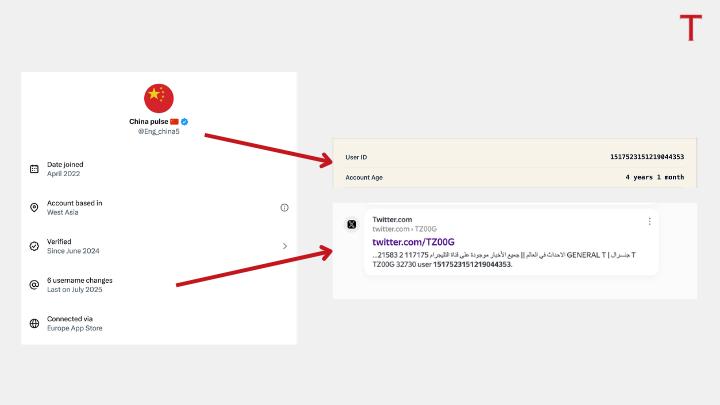
Further searches on X revealed that TZ00G routinely posted Arabic-language content throughout 2022-2024. China Pulse only switched to English in 2025.
From the start, the account actively spread positive information about China. Entering 2026, it began spreading narratives about closeness between China-Pakistan. Tempo sent a request for confirmation to China Pulse via X, but had not received a response as of Friday afternoon, May 15, 2026.
Bot Network and Pro-China, Pro-Pakistan Accounts Amplify the Claim
Tempo partnered with ThinkFI, an Indian data research company that frequently detects information manipulation and cyber propaganda, to analyze 1,733 accounts that spread China Pulse’s post on X. The team extracted data from users’ profile descriptions, names, locations, and political affiliations to identify account clusters.
The analysis showed that around 1,300 accounts were organic or controlled by humans. However, the collaborative team found 52 accounts strongly suspected of being run by robots or bots with extremely high activity.
Bot accounts are controlled automatically or semi-automatically by computer programs, not humans. Bots are designed to imitate behavior such as liking, following, commenting, or posting content.
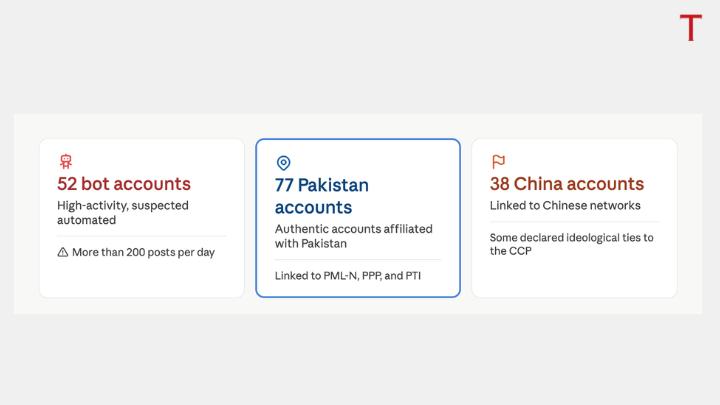
One indicator of a bot account is that it can post more than 200 times per day. “[Its] behavior that is impossible for humans,” ThinkFI Director Rohit Sharma told Tempo via email on Tuesday, May 12, 2026.
The account @bilim8888, for example, posted an average of 705 tweets per day, or one tweet every two minutes. The same analysis also identified 77 authentic accounts affiliated with Pakistan, including links to political parties in the country such as the Pakistan Muslim League, or PML-N, the Pakistan Peoples Party, or PPP, and Pakistan Tehreek-e-Insaf, or PTI.
Meanwhile, 38 other accounts were detected as having links to China. Some even listed ideological ties to the Chinese Communist Party (CCP).
How Rafale Became a Disinformation Target in 2025
The involvement of accounts from Pakistan and China stems from the war between India and Pakistan on May 7, 2025. Pakistan, the only country outside China that operates the J-10 as well as Chinese-made PL-15 missiles, claimed to have shot down five Indian jets: three Rafales, one MiG-29, and one Su-30.
India acknowledged losing fighter jets but did not specify the number. A Reuters investigation said only one Rafale had been brought down.
Citing several Indian and Pakistani officials, Reuters reported that the Rafale’s performance was not the main issue. Rather, the problem was India’s intelligence failure in mapping the range of the PL-15 missile fired by the J-10C.
The narrative of the J-10’s victory over the Rafale triggered a wave of disinformation in Indonesia. Tempo identified 475 Facebook posts from May 7-31, 2025, claiming that Pakistan’s J-10 had shot down three to five Indian Rafales. Some posts were accompanied by AI-generated visuals or footage taken from video games.
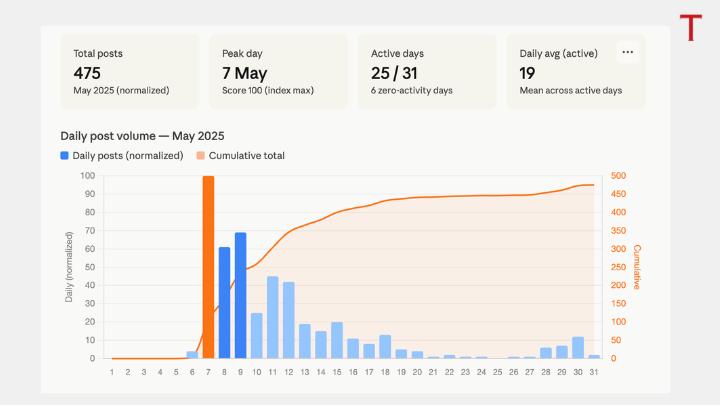 Analysis of Facebook post volume from May 7 to May 31, 2025, featuring the narrative that Pakistan’s J-10C successfully shot down three to five Indian Rafale fighter jets. Data processed using Claude.ai.
Tempo had previously analyzed a series of disinformation items related to this issue, such as hoaxes about Rafale debris being found, claims of a Pakistani female pilot shooting down enemy jets, and the narrative of one J-10 taking on six Indian Rafales.
In addition, a parody video titled My New Plane Got Shot Down, set to the tune of Daler Mehndi’s song “Tunak Tunak Tun,” also went viral in Indonesia. The lyrics of the Indian pop song were deliberately modified to mock the downing of New Delhi’s new fighter jet.
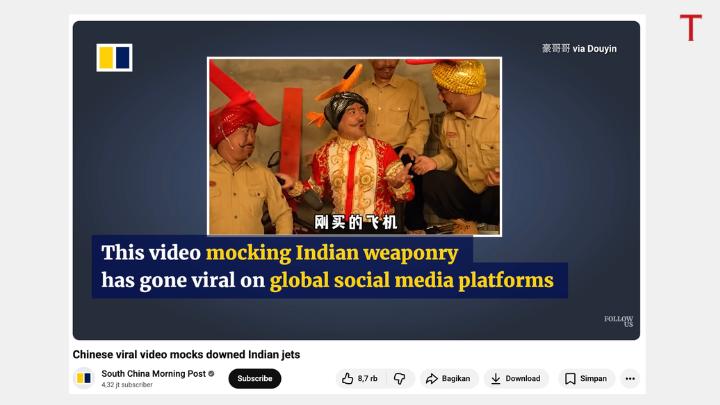
A South China Morning Post report said the video was created by Brother Hao, a Chinese influencer. The content first appeared on Douyin on May 10, 2025, before spreading to other platforms such as Weibo, QQ, Sohu, and Zhihu.
In Indonesia, this wave of disinformation was accompanied by the emergence of the hashtag #HentikanRafaleDeal (Stop Rafale Deal) on X from June 11-27, 2025. However, Tempo’s investigation with ThinkFI found strong indications of an engineered, coordinated campaign behind the movement.
Hashtag Movement Pattern
The campaign peaked on June 11, 2025, with a total of 286 tweets. There was an unusual pattern behind the campaign. One sign was a drastic spike in posts on X, with 268 tweets circulating in just one hour, from 01:00 PM to 02:00 PM Western Indonesia Time.
Another anomaly was that the hashtag was pushed by accounts that had only been created in 2025, shortly before the operation began. The hashtag’s lifespan was also short: it disappeared or sank immediately after the extreme spike in posts.
The network behind the hashtag applied a systematic two-tier division of labor. Accounts with few followers acted as early seeders of the content. Meanwhile, accounts with larger followings amplified the narrative through replies to increase visibility.
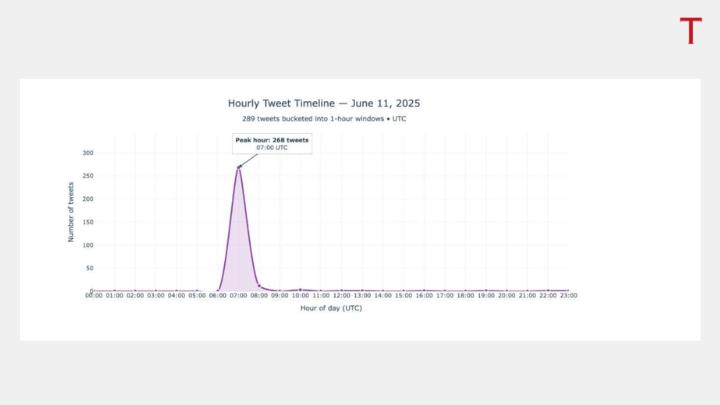
Rohit Sharma from ThinkFi said the pattern was the opposite of organic hashtag growth. According to him, authentic grassroots conversations usually develop gradually, peak over several days, and then slowly decline.
By contrast, the #HentikanRafaleDeal (#StopRafaleDeal) movement appeared planned and time-limited. “Participants were mobilized simultaneously and stopped immediately after the task was completed,” Rohit said.
Aimed at Influencing Public Opinion
Macquarie University postdoctoral researcher Nava Nuraniyah said the 2025 India-Pakistan war became a strategic arena to test Chinese military technology in the eyes of the world. Unlike Western manufacturers, Chinese military technology has not been widely tested in open combat.
“Information about the Rafale’s defeat benefits the marketing of Chinese military equipment,” Nava told Tempo at Senayan Park, Central Jakarta, on Tuesday, May 12, 2026.
Nava explained that the information operation aimed to influence public opinion in order to legitimize government policy in buying primary weapons systems, or defense equipment, from certain countries. But Indonesia was not the only target.
According to Nava, China has an interest in showing its strength in the global market because Pakistan is currently the main user of its technology. “Information about the Rafale’s defeat benefits the marketing of Chinese military equipment,” Nava said.
Military and defense observer Beni Sukandi, from the defense and security consultancy MARAPI, warned that defense procurement should not be influenced by opinions emerging on social media. Instead, it must consider interoperability, or the ability of different technology systems to communicate and exchange data securely.
So far, Indonesia has relied on Western fighter jets whose communication systems are already integrated. “Indonesia has never had fighter jets from China, so technology adoption and interoperability will be difficult,” Beni told Tempo on Wednesday, May 13, 2026.
Beni said the Rafale crash incident in the India-Pakistan war could not serve as the sole benchmark for fighter jet procurement. According to him, an aircraft’s reliability in open warfare depends heavily on its supporting ecosystem, from pilot skill, communication and radar systems, to satellite support.
“In India’s case, there was a failure or delay on the information side, not an issue with Rafale’s performance,” Beni said.
Tempo sent a request for comment to AVIC Aviation Industry Corporation of China via email. But as of Friday afternoon, May 15, 2026, the company had not responded.
This report is part of the Indo-Pacific Resilience Program, supported by Internews and the European Union.
Ahmad Suudi contributed to the writing of this report.
TEMPO FACT-CHECK TEAM
**Do you have information or claims that you want to have fact-checked? Contact our ChatBot. You can also send criticism, objections, or feedback for this Fact-Checking article via email to [email protected].