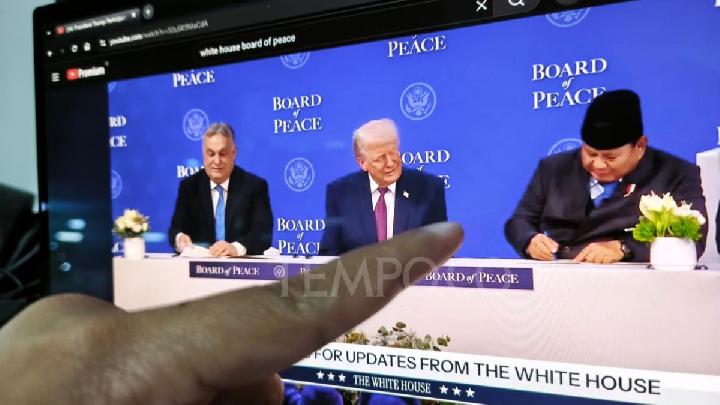
TEMPO.CO, Jakarta - The Board of Peace established by US President Donald Trump will hold its inaugural meeting on Thursday, February 19, 2026, in Washington. Although the US calls this the inaugural meeting, council members met last month in Switzerland for a signing ceremony during the World Economic Forum.
They are scheduled to discuss Gaza reconstruction, though questions remain whether Hamas will disarm and if Israel will agree to further withdrawal from the Gaza Strip so reconstruction can proceed.
More than 20 countries are expected to attend the meeting of the Peace Council (BoP) established by US President Donald Trump, White House Press Secretary Karoline Leavitt said on Wednesday.
According to her at a press conference, as quoted by Antara, there are more than 20 countries that will attend the Peace Council meeting on February 19, and many are interested in it.
She promised a list of participants would be provided later, along with details regarding each country's contribution to the council.
Leavitt also stated that Trump is scheduled to open the event with a speech and will formally chair the meeting before departing for Georgia.
In January, Trump announced the formation of the Peace Council and invited approximately 50 countries to join. According to the White House, the organization aims to support Gaza reconstruction and the path to peace.
To date, 26 countries have joined as founding members of the council. At least 14 countries have declined the invitation.
As reported by The Times of Israel, this meeting takes place nearly four months after the Trump administration brokered a Gaza ceasefire that allowed the release of all remaining Israeli hostages.
Since then, however, Israel has violated the ceasefire almost daily, killing more than 600 Palestinians, including over 100 children.
Praising the council's "unlimited potential," Trump wrote on Truth Social: "The Board of Peace will prove to be the most consequential International Body in History."
Critics have condemned Trump's "imperialist agenda" and the expansion of the council's charter, which analysts view as a rival to the United Nations.
Trump has also faced criticism for offering council seats to Benjamin Netanyahu and Vladimir Putin, both wanted for war crimes by the International Criminal Court (ICC).
So far, only Netanyahu has formally accepted the offer, despite friction over the inclusion of Turkey and Qatar, supporters of Palestine, on the Gaza Executive Board.
For some attendees in Washington on Thursday, the stakes are both diplomatic and domestic, as decisions regarding the occupied Palestinian territories could have repercussions at home.
Who's Coming?
The US invited heads of state to join Trump at the Washington conference, but many chose not to attend. Bahrain's King Hamad Al Khalifa was the only Middle Eastern head of state to make the trip. Indonesian President Prabowo Subianto is also scheduled to attend the meeting.
Nearly fifty countries will still be represented, with Israel, Jordan, the United Arab Emirates, Saudi Arabia, Egypt, Turkey, Qatar, and others sending foreign ministers or senior cabinet members.
The Palestinian Authority was not invited, but Ali Shaath, chief commissioner of the National Committee for the Administration of Gaza (NCAG), will attend, according to Arab diplomats and a senior US official.
Shaath's committee of Palestinian technocrats is tasked with replacing Hamas, but the NCAG has not yet entered Gaza. The Board of Peace’s Gaza High Representative Nickolay Mladenov stated last week that entry is impossible if ceasefire violations continue.
Several European countries that avoided joining the council due to legal concerns or fears of weakening the UN will participate as observers, the senior US official said.
Major powers, including France, Germany, Britain, and Spain, declined invitations to join as full members.
Despite concerns, the European Union sent Commissioner Dubravka Suica as an observer. A spokesperson said that while questions remain, the EU will work with the US on the Gaza peace plan.
Although the EU has not joined as a body, member states Hungary and Bulgaria have. Hungarian Prime Minister Viktor Orban, a close Trump ally, attended the meeting.
Kosovo and Albania have also joined the council and will attend the session.
Italy, Cyprus, Greece, and Romania confirmed they will send observers. Romanian President Nicusor Dan will attend in person.
Meanwhile, Pope Leo XIV declined an invitation to the council, stating that the United Nations should handle crisis situations.
Several major Middle Eastern powers have joined Trump's initiative.
From Israel, Foreign Minister Gideon Saar will attend the meeting on Thursday.
Longtime US allies the United Arab Emirates, Morocco, and Bahrain were among the first Arab states to join, followed by Egypt.
Saudi Arabia, Turkey, Jordan, and Qatar also joined, declaring their commitment to Palestinian self-determination and international law. Kuwait later joined, and all these nations sent delegations.
Tahani Mustafa, a fellow at the European Council on Foreign Relations, told Al Jazeera that Western allies remain committed to the liberal order. Other countries in the South are more pragmatic regarding council membership.
“Middle Eastern partners say they’re trying to be pragmatic and do what they think is best for Gaza and to stop the bloodshed,” said Mustafa, a former analyst at the International Crisis Group.
“The reality, ultimately, is that this is more about strengthening their relationship with the US, and not upsetting someone as temperamental as Trump,” he told Al Jazeera. Furthermore, Mustafa argued, “The Middle Eastern countries also have a notorious record of not being the best advocates for Palestine, especially in recent decades.”
Read: Trump's Board of Peace Set for Inaugural Meeting on Gaza
Click here to get the latest news updates from Tempo on Google News