The Indonesian military (TNI) is involved in a project to construct the Red and White Village Cooperative building. It is prone to abuse of power.
DURING the Soeharto era, the government ran the “ABRI Masuk Desa” (Indonesian Armed Forces in the Villages) program. Around three decades later, President Prabowo Subianto is launching the “Indonesian Military in Village Cooperatives” project.
The involvement of soldiers in the construction of Red and White Village Cooperative buildings is prone to the abuse of power. Although described as a gotong-royong (mutual cooperation) effort, these cooperatives rely on capital sourced from state-owned banks.
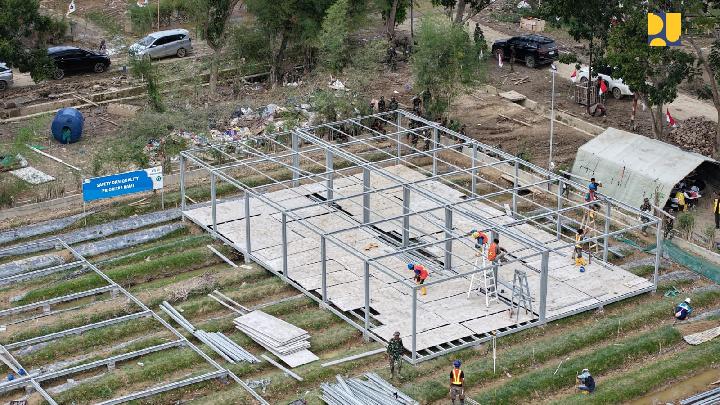
In its development, the government has involved the military in constructing Red and White Cooperative buildings across 75,266 villages. The involvement is governed only by an agreement with Agrinas Pangan Nusantara, a state-owned company tasked with constructing the buildings.
The cooperative building project is clearly not a “military operation other than war,” which is a legitimate TNI function. The military’s involvement is not even one of the functions regulated by the TNI Law, namely assisting regional governments’ tasks.
In this project, soldiers are involved in everything from drafting proposals and budget requests to applying for bank loans, drafting contractor agreements, physical construction, reporting to Agrinas, and even daily project supervision.
Agrinas Pangan considers that only the military has the capability and command structure necessary to realize the construction of the Red and White Cooperative buildings.
This seems reasonable. However, in reality, the troops’ deployment does not meet the prerequisites of good governance. Upon closer inspection, the military’s involvement in economic activities such as building-construction projects can be categorized as violating the law.
The Prabowo administration appears to be forcing village-level cooperatives to acquire buildings immediately. Yet, to operate as healthy and naturally growing businesses, cooperatives could simply rent facilities if they are not yet capable of building them. By growing organically, these new cooperatives could eventually achieve their founding purpose: improving the welfare of rural communities.
The Prabowo administration seems to rely solely on the military to achieve its programs, as well as all its flagship projects. In addition to constructing the Red and White Village Cooperative buildings, the government also relies on the military and police in running the free nutritious meals project.
Prabowo evidently needs a military-style chain of command to execute all these programs. In many cases, the military serves as a tool for pressure and intimidation whenever government programs stall on the ground.
This effort to govern through threats and the spreading of fear moves the country closer to the practices of a military regime. The characteristics of such a model rely on top-down, command-style political decision-making.
The government creates order and stability through coercion, displaying low transparency and restricting civil liberties. While such a governing style might achieve the ruler’s political objectives quickly, those achievements are, in reality, extremely fragile.
Not to mention that the budget for constructing these buildings uses village fund allocations intended for village development. Agrinas Pangan received Rp3 billion in funding for the construction of Red and White Cooperative buildings for every village. The legal violations in Prabowo's priority program have become increasingly layered.