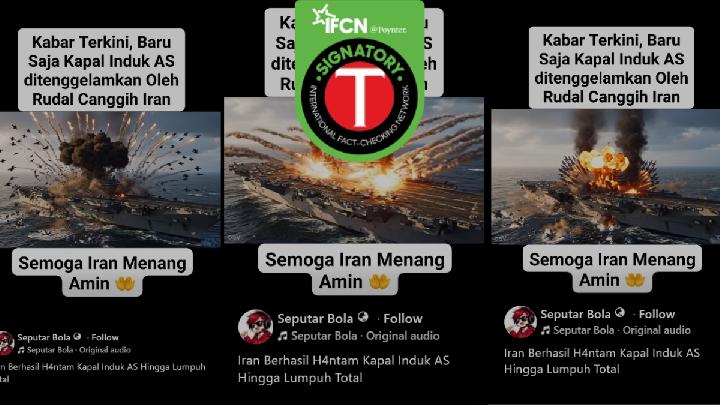
TEMPO.CO, Jakarta - A content claiming that a cure for cancer was suddenly discovered worldwide after the United States (US) withdrew from the World Health Organization (WHO) is circulating on TikTok [archive], Facebook, and YouTube.
The content, uploaded on February 12, 2026, features several graphics and narratives. It alleges that countries such as Spain, Korea, and Russia have discovered drugs and vaccines to treat cancer. The uploader accuses the global pharmaceutical industry of hiding the facts so that people receive chemotherapy, which costs trillions of rupiah.
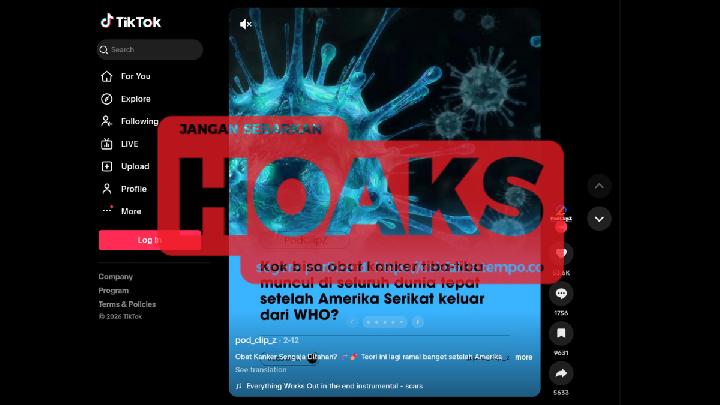
But is it true that cancer drugs were deliberately released after the US withdrew from the WHO?
FACT CHECK
Tempo's Fact Check team interviewed cancer experts and compared their findings with credible sources. The results showed that there is no link between the discovery of cancer treatments and vaccines and the United States' withdrawal from the WHO.
The United States (US) withdrew from the World Health Organization (WHO) through an executive order issued by Donald Trump on January 20, 2025. Research to develop cancer therapies, drugs, and vaccines has been ongoing for 250 years.
Even drugs and vaccines for certain types of cancer have been approved for human use by the United States Food and Drug Administration (FDA). This move predates Donald Trump's withdrawal from the WHO. To this day, research and development of therapies, drugs, and vaccines to cure cancer continues to be conducted by scientists in several countries.
Cancer Vaccine Discovery Not Related to America's Withdrawal from the WHO
A cancer researcher from YARSI University, Ahmad Rusdan Handoyo Utomo, Ph.D., said vaccines for certain types of cancer are already used worldwide, including in Indonesia. One example is the HPV vaccine, which prevents human papillomavirus infection, which causes cervical, vulvar, vaginal, anal, penile, and genital wart cancers.
"The HPV vaccine is currently available free of charge to elementary school children," Ahmad told Tempo on Sunday, February 22, 2026.
Ahmad stated that there is no attempt to hide cancer drugs or vaccines. This is because vaccines can only be used in humans through a lengthy clinical trial phase.
The discovery of a potential drug for pancreatic cancer, led by Spanish cancer researcher Mariano Barbacid, for example, has successfully cured the disease in mice. However, the drug isn't immediately available for use in humans. According to Elpais.com, the cancer drug hasn't yet reached the clinical trials stage in humans.
Professor Zubairi Djoerban, a professor at the University of Indonesia's Faculty of Medicine, also explained that after animal testing, drug or vaccine candidates must undergo phase I trials involving 20 to 50 healthy individuals. Once declared safe, they must then proceed to phase II trials involving 100-200 patients. Phase III trials must involve at least 500 individuals.
"Only then must the product receive regulatory approval, be used, and be mass-marketed," Zubairi said.
Cancer Therapy Research Began Long Before America Left the WHO
The United States Cancer Institute notes that scientists have been researching and discovering therapies to treat cancer worldwide for 250 years. Beginning in 1775, scientist Percivall Pott identified a link between exposure to chimney ash and the development of a rare form of squamous cell skin cancer.
Since then, scientists have continued to pursue a cure through various methods, from radiation in 1899 and the immune system in 1909 to the Pap smear technique in 1928. Medical advances have also accelerated, with the introduction of mastectomies and hormonal therapy in 1941, combined chemotherapy in 1958, and liquid biopsies in 2020.
The United States Food and Drug Administration (FDA) also approved the use of sipuleucel T as the first human cancer vaccine in 2010. The medical authority also approved belzutifan, or Welireg, in 2021 to treat tumors caused by Von Hippel-Lindau syndrome. All of these medical achievements were realized long before Donald Trump signed the order to withdraw from the WHO.
Recent news from Russia indicates that the Federal Medical and Biological Agency (FMBA) is testing Enteromix, an mRNA-based vaccine whose research has been ongoing for more than three years. The head of the Federal Medical and Biological Agency (FMBA), Veronica Skvortsova, claimed the vaccine has proven effective in shrinking tumors in animal trials.
Russia is currently awaiting regulatory approval to release Enteromix for wider public availability.
Meanwhile, in South Korea, researchers at the Korea Institute of Science and Technology (KAIST) recently announced a method for reprogramming immune cells in tumors into cancer-killing machines. A drug injected directly into the tumor is absorbed by macrophages, triggering them to recognize and attack cancer cells while activating the surrounding immune defenses.
This method is also currently in animal testing. Preclinical results showed significant slowing of tumor growth and triggering a strong anticancer immune response. They plan to conduct human clinical trials in 2027.
CONCLUSION
Tempo's verification concluded that the claim that the cancer drug was deliberately released after the US withdrew from the WHO is false.
TEMPO FACT-CHECK TEAM
**Do you have information or claims that you want to have fact-checked? Contact our ChatBot. You can also send criticism, objections, or feedback for this Fact-Checking article via email to [email protected].