TEMPO.CO, Jakarta - President Prabowo Subianto announced that Indonesia has officially achieved self-sufficiency in rice production, specifically by the year 2025. He made the statement while attending a harvest festival in Karawang Regency, West Java, on Wednesday, December 7, 2026.
"With the words bismillahirrahmanirrahim, this morning, on Wednesday, January 7, 2026, I, Prabowo Subianto, President of the Republic of Indonesia, hereby announce the achievement of self-sufficiency in rice production for the entire Indonesian nation. Thank you," said President Prabowo, who immediately pounded the pestle into the mortar as a symbol of achieving self-sufficiency in rice, as quoted from Antara.
The announcement was made by the Head of State, accompanied by Agriculture Minister Andi Amran Sulaiman, Coordinating Minister for Food Zulkifli Hasan, or Zulhas, and representatives of the farming community. They also pounded the pestle into the mortar with the President.
In his speech at the event, Prabowo expressed his pride and joy over the achievement of self-sufficiency. In front of the farmers, agricultural extension workers, and the entire Indonesian farming community, he thanked them for their hard work.
"Thank you, the entire farming community in Indonesia, you have worked hard, you have united, you have produced in the last four years, you have given to the nation and the country. We have achieved self-sufficiency, in one year, we are standing on our own feet, in one year, we are no longer dependent on other nations," said President Prabowo, welcomed by the applause of the farmers.
Furthermore, the President pointed out that the farmers have proven themselves to be the nation's best sons and daughters. He also criticized the behavior of some elites who more often mock and criticize the government's performance.
"The important thing, brothers and sisters, today you (farmers) have provided real evidence. In my opinion, you have recorded a significant milestone in Indonesia's independence," said Prabowo.
On this occasion, Prabowo awarded the highest service star to Agriculture Minister Amran Sulaiman. "He, along with your team, all of you, have secured the future of the Indonesian nation. And I believe, after this, we will not be able to be stopped," said the Head of State.
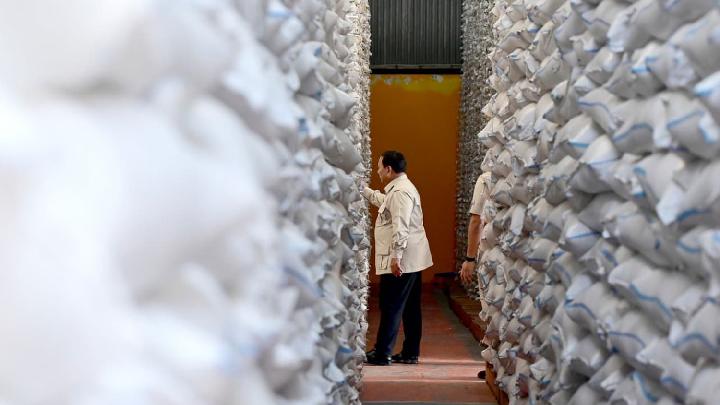
Previously, senior policy analyst and researcher at the Center for Indonesian Policy Studies (CIPS), Hasran, highlighted the government's decision to halt rice and sugar consumption imports in 2026 to achieve food self-sufficiency. He viewed this move as demonstrating high optimism regarding domestic food production. However, the claim of food self-sufficiency must be tested against reality.
According to Hasran, local food production is now increasingly vulnerable to unpredictable extreme weather. "Don't let the intention to achieve self-sufficiency by limiting imports actually burden the people with high food prices," he said in a written statement on Tuesday, January 6, 2025.
Last December, in determining the 2026 Commodity Balance (NK), the government officially stopped importing rice and sugar. Imports were limited only to specific industrial raw materials, such as special industrial beef and special industrial salt.
Hasran emphasized that without a responsive import mechanism, efforts to protect farmers and consumers could actually risk triggering market upheavals. In the event of a sudden crop failure requiring emergency imports, the government must start the bureaucratic process from scratch to revise the NK quotas.
He stated that this situation will become a gamble when facing significant moments such as the Ramadan and Eid al-Fitr period. If disturbances occur at that time, the spike in food prices has the potential to harm the public.
Therefore, CIPS requests that the government first prove the claim of food self-sufficiency with valid cross-institutional data. He emphasized that measurement errors could result in shortages of the food supply.
Moreover, according to Hasran, a resilient food self-sufficiency is not only measured by production achievements in a single annual cycle. These aspirations require a food system that can respond to real threats, such as climate crises and crop failures.
Read: Indonesia Records Trade Surplus for 67 Consecutive Months
Click here to get the latest news updates from Tempo on Google News